
Dental
Implants in Malabar Hill, Mumbai
A long-term replacement for missing teeth, planned around bone, bite, gums and the way you actually use your mouth.
9 min readUpdated 28 October 2026Malabar Hill, Mumbai
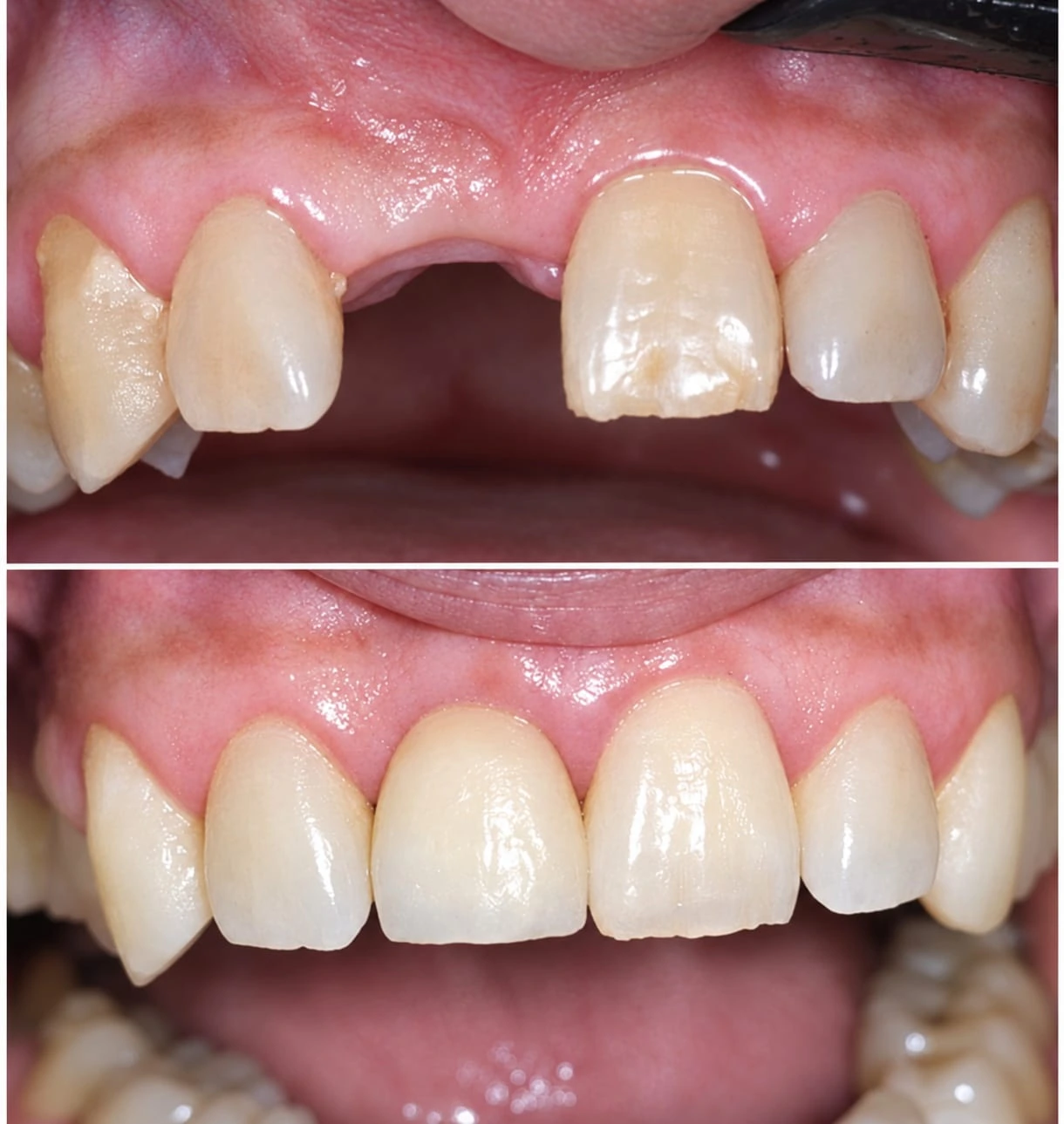
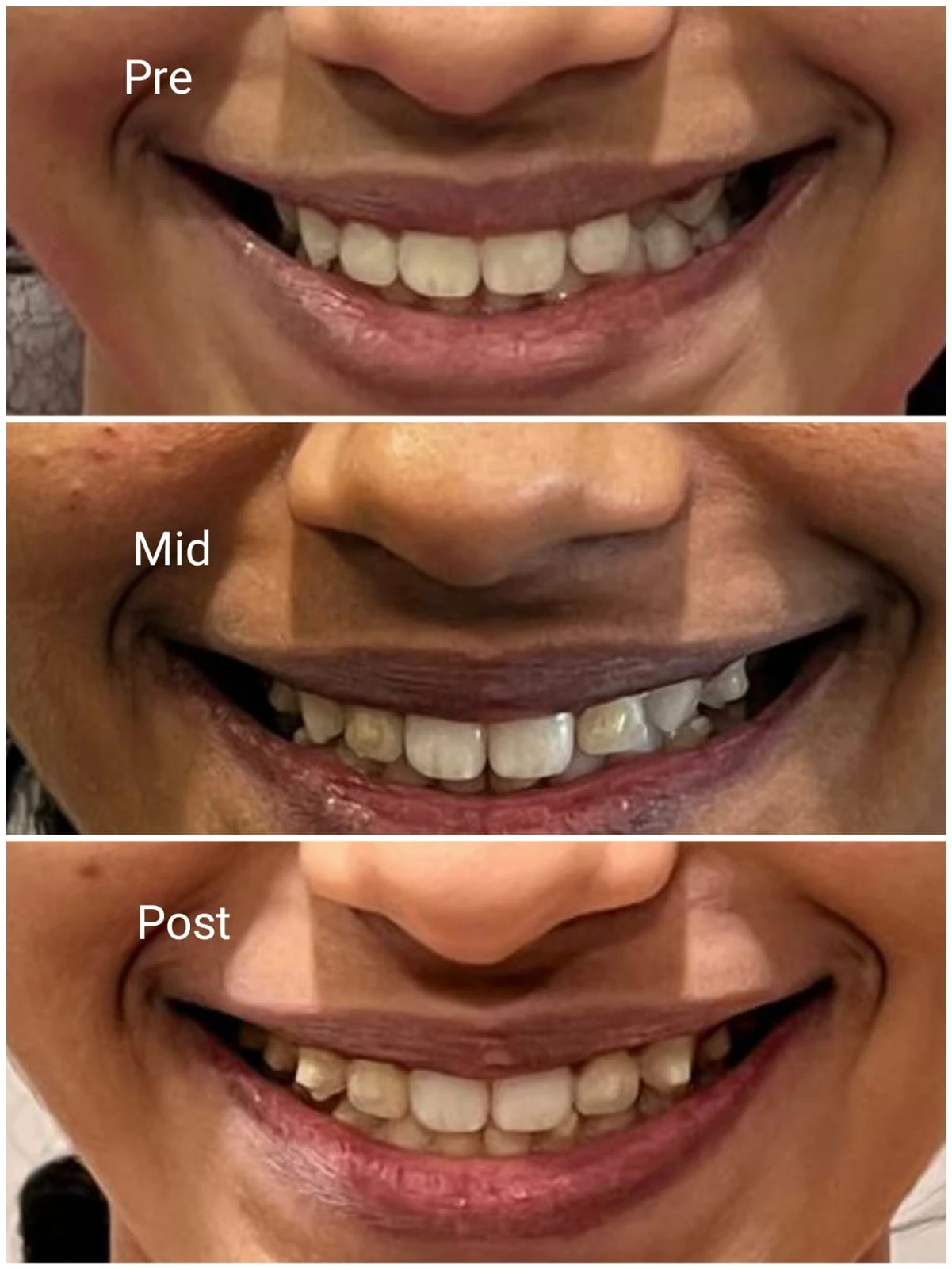
Single-tooth implant restoration: before (top) and after (bottom). Clinical images shared with consent.
≈95%
Published 10-year implant survival
Bone first
Grafting planned when needed
Maintenance
Reviews protect the investment
A replacement root, not just a replacement tooth
The short answer
A dental implant is a titanium root replacement placed in the jaw to support a crown, bridge or full-arch prosthesis. It can replace one tooth without cutting down healthy neighbours, or support a larger reconstruction when several teeth are missing. Implants are not suitable for everyone: bone volume, gum health, smoking, diabetes control, bite forces and maintenance all matter. Planning begins with a clinical examination and, where indicated, a CBCT scan.
A dental implant is a small titanium fixture that is placed into the jawbone and allowed to integrate with the bone. Once healed, it can support a single crown, a bridge or a larger prosthesis. The visible tooth is the crown; the implant is the foundation beneath the gum.
The main advantage is that an implant can replace a missing tooth without preparing the adjacent healthy teeth, as a conventional bridge would. Implants can also help support a denture or a full-arch prosthesis when several teeth are missing. The main trade-off is that implant treatment is a surgical procedure with healing time, and it requires a commitment to maintenance.
At Smile Clinique, implant planning is prosthetically driven: the final tooth position and bite are considered before the implant position. A CBCT scan is used when indicated to assess bone volume, nerves, sinuses and the relationship between the planned implant and the final crown.
Single-tooth implant restoration: before (top) and after (bottom). Clinical images shared with consent.

Clinical guidance
Dr. Nidhi Mehta, BDS
Founder, Smile Clinique
When an implant may be considered
One missing tooth
You want to replace a single tooth without cutting down the two healthy teeth next to it.
Several missing teeth
An implant-supported bridge can restore a segment without relying on natural abutments.
A loose or uncomfortable denture
Implants can stabilise a removable denture or support a fixed full-arch prosthesis.
A tooth that cannot be saved
After extraction, an implant may be planned once the site has healed and infection is controlled.
Bite changes after tooth loss
Drifting teeth or a collapsed bite may be stabilised as part of a broader reconstruction.
A need for fixed function
You prefer a fixed solution and are prepared for the surgical and maintenance commitment.
A good fit if you are
- Adults with missing teeth and adequate bone, or bone that can be grafted
- People with healthy gums or gum disease that has been treated and stabilised
- Patients who can attend follow-up visits and maintain hygiene
- Cases where the final crown or prosthesis can be planned before surgery
Not the right starting point if
- Uncontrolled diabetes, active infection or untreated gum disease
- Heavy smoking that cannot be reduced around surgery and healing
- A bite or parafunction problem that has not been assessed
This list is a guide, not a diagnosis. Suitability is confirmed only after an in-person examination.
One implant, a bridge, or a full arch
The number and position of implants are chosen from the prosthetic goal and the available bone — not from a fixed package.
Single tooth implant
Best for · One missing tooth with healthy neighbours
A single implant supports one crown, preserving the adjacent teeth. The most conservative option when the site is suitable.
Implant-supported bridge
Best for · Several adjacent missing teeth
Two or more implants support a bridge, avoiding a long-span conventional bridge on natural teeth.
Implant-stabilised denture
Best for · A removable denture that needs more stability
A smaller number of implants can improve retention and comfort without committing to a full fixed arch.
Full-arch implant rehabilitation
Best for · Most or all teeth missing in one or both arches
A fixed or removable prosthesis supported by four or more implants, planned around bone volume and bite forces.
The implant pathway
Good implant dentistry is mostly planning. The surgery is the short part; the diagnosis and the final restoration determine the outcome.
Examination and imaging
We assess the missing tooth space, gums, bite, bone and medical history. A CBCT scan is used when indicated to measure bone and identify anatomy.
Prosthetic plan
The final crown or prosthesis is designed first, so the implant is placed where the tooth needs to be — not simply where the bone looks easiest.
Implant placement
The implant is placed under local anaesthesia, with a guided or freehand approach depending on the case. Bone grafting may be performed at the same time or as a separate stage.
Healing and integration
Osseointegration usually takes several weeks to months. Temporary arrangements are planned so you are not left without a functional appearance.
Abutment, crown and maintenance
The final restoration is fitted and the bite is checked. Regular reviews and hygiene visits protect the implant and the surrounding gum.
What the literature actually says
Dental implants are one of the most extensively studied dental treatments. The evidence supports high long-term retention, but it also shows an important distinction: an implant can survive without being biologically healthy. Success depends on the gum, bone, bite and maintenance around it.
How to read this
Survival is not the same as success. A restoration or implant can remain in place while needing repair, hygiene treatment or replacement. The figures below are population averages, not personal guarantees.
≈95%
10-year implant survival
A 2026 meta-analysis of 34 studies, 7,522 patients and 20,445 implants reported approximately 95% survival after 10–25 years, with pooled failure around 4.8%–5.1%.
95.4% / 92.8%
5- and 10-year survival for implant-supported fixed prostheses
The ITI consensus database reports cumulative implant survival of 95.4% at 5 years and 92.8% at 10 years for implants supporting fixed partial dentures.
≈85%
Success is lower than survival
The 2026 review found average success of 85.1% across 14 studies, but definitions varied substantially. Survival alone does not prove biological health or absence of complications.
10.8%
Implant-level peri-implantitis in long-term data
The same review reported a descriptive mean of 10.8% for implant-level peri-implantitis, with a wide range across studies — a reminder that maintenance and monitoring matter.
Implant survival figures are population averages, not personal guarantees. Smoking, uncontrolled diabetes, gum disease, bone quantity, grinding, the prosthetic plan, surgical technique and follow-up all affect the result. A CBCT and clinical examination are needed before anyone can tell you whether an implant is the right option.
Selected sources
Moraschini et al., Periodontology 2000 (2026)
Systematic review and meta-analysis of implant survival, success and biological outcomes beyond 10 years.
ITI Consensus: Implant Survival and Complications
International Team for Implantology consensus statements on implant and prosthesis survival.
Howe et al., Journal of Dentistry (2019)
Systematic review and sensitivity meta-analysis of 10-year dental implant survival.
Moraschini et al., International Journal of Oral and Maxillofacial Surgery (2014)
Long-term implant survival and marginal bone loss in studies with at least 10 years of follow-up.
The difference is in the planning
Preserves neighbouring teeth
A single implant can replace a tooth without cutting down the healthy teeth on either side.
Bone and bite support
An implant-supported restoration can help maintain bone and support a stable bite when teeth are missing.
Fixed or removable options
From one crown to a full-arch prosthesis, the plan can be tailored to the clinical situation and your preferences.
Designed for maintenance
The restoration is contoured for cleaning, and reviews are scheduled to monitor the gum and bone around the implant.
Tools that support judgement
CBCT imaging
Three-dimensional scans help assess bone height, width, nerves and sinus anatomy before surgery.
Guided surgery
A surgical guide can transfer the digital plan to the mouth when the case is suitable, improving precision and predictability.
Digital impressions
Scans are used to design the final crown or prosthesis and to communicate with the laboratory.
Prosthetic-led planning
The final tooth position is designed before the implant is placed, so the restoration is not an afterthought.
A real single-tooth implant case
Clinical images from a patient treated at Smile Clinique in Malabar Hill, Mumbai, shared with the patient's consent. Individual results vary.
Before / AfterReal patient case · Malabar Hill, Mumbai
Single-tooth implant restoration
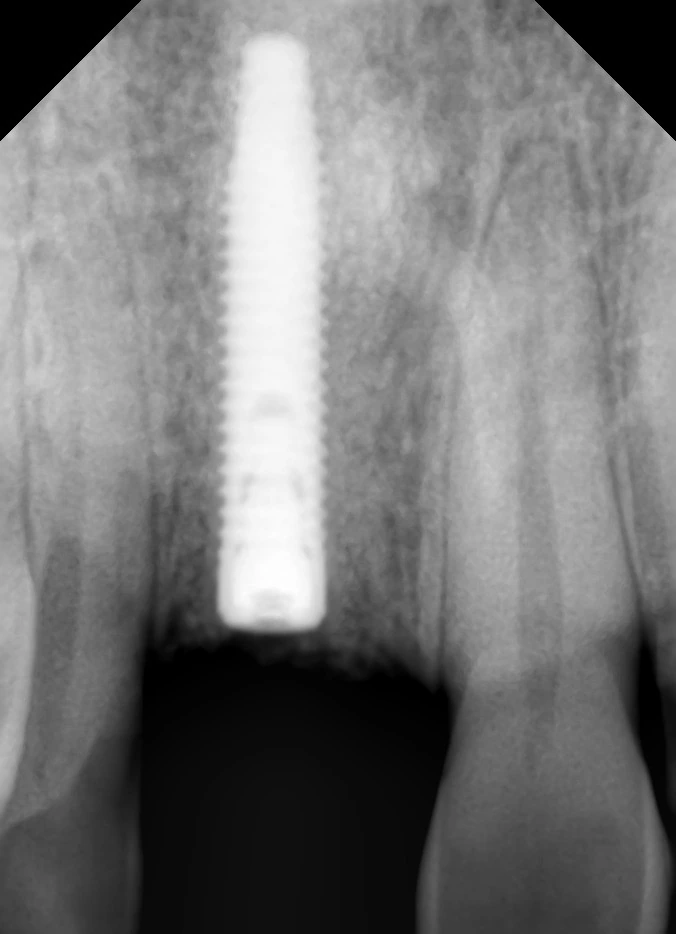
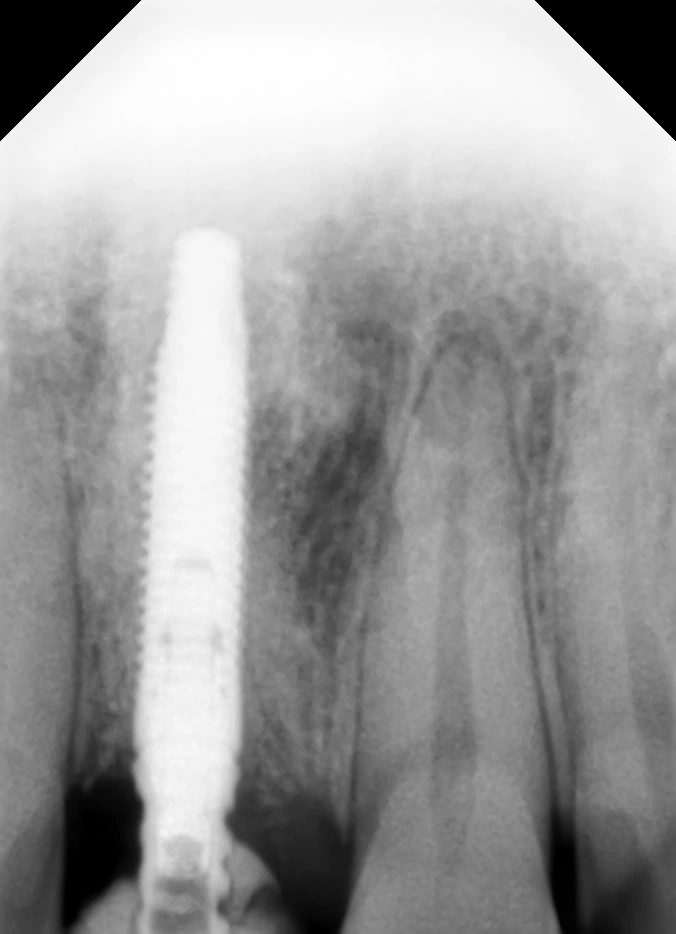
This patient presented with a missing upper central incisor. The case was planned with a radiograph, an implant fixture was placed, and the final restoration was returned to function and appearance.
Patient images shared with consent. No identifying details shown. Individual results vary.
Discuss a similar case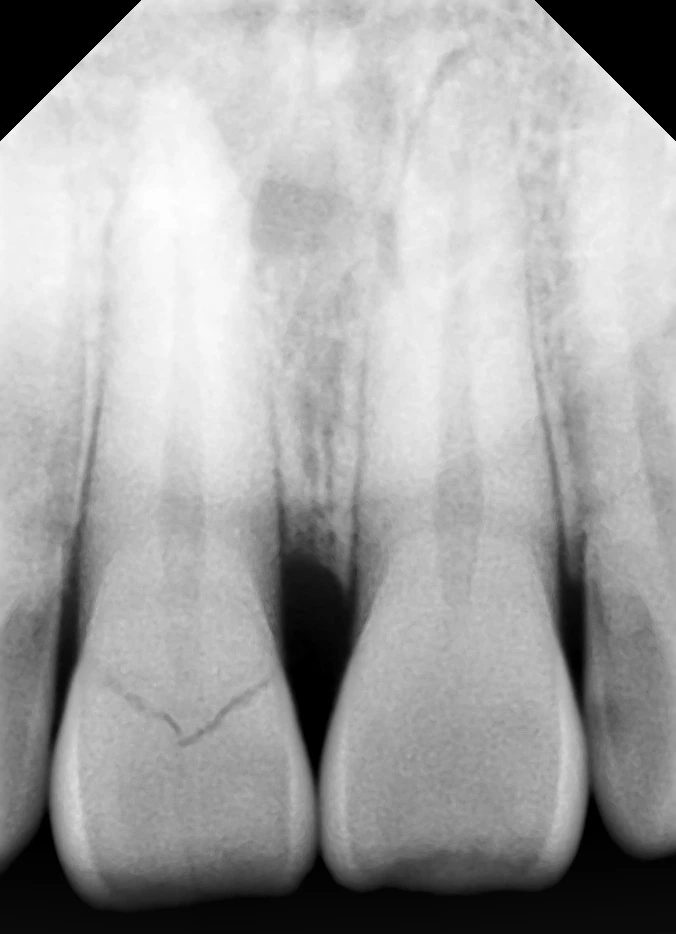
Protect the result, not just the visit
After surgery
- Follow the written instructions for medication, ice and rest.
- Do not disturb the surgical site or use straws vigorously in the early period.
- Report severe pain, bleeding, swelling or fever promptly.
Healing phase
- Keep the area clean with the recommended rinses and gentle brushing.
- Avoid smoking; it impairs healing and increases failure risk.
- Attend the review appointments even if everything feels fine.
Daily care
- Clean around the implant and the restoration with the recommended brushes and interdental aids.
- Use a soft brush and avoid abrasive materials on the prosthesis.
- If you grind, wear the night guard as instructed.
Long-term monitoring
- Keep regular hygiene reviews to check gum health and bone levels.
- Report bleeding, swelling or looseness early.
- Maintain good diabetes control and discuss medication changes with your dentist.
Risks and honest limitations
- Bleeding, swelling, bruising and discomfort after surgery.
- Infection, delayed healing or failure of the implant to integrate.
- Damage to nearby nerves, roots or sinuses, depending on anatomy.
- Bone graft or sinus lift complications, including graft failure.
- Peri-implant inflammation or bone loss over time, especially with smoking or poor hygiene.
- Loosening, fracture or wear of the crown, abutment or prosthesis.
Important
This page is educational and does not replace a clinical examination. Every treatment carries risks, and not every patient is a candidate. Ask questions, request a written plan, and seek a second opinion if you need one.
What changes the cost of dental implants in Mumbai
Implant pricing is not just the price of a screw. It includes diagnosis, imaging, surgery, components, healing time, the final crown or prosthesis and maintenance. A quote should make those inclusions clear.
What a good quote should include
At Smile Clinique, the implant system and components are discussed as part of the written plan. Ask whether the quote includes imaging, grafting, the abutment, the final crown and reviews. The cheapest implant is not necessarily the cheapest treatment if it excludes the parts you will need.
Request a written planWhat changes the price
Number of implants and whether a single crown, bridge or full arch is planned
Implant system and prosthetic components selected for the case
Bone grafting, sinus lift or extraction
CBCT imaging, surgical guides and laboratory work
Temporary prosthesis or provisional tooth during healing
Follow-up, hygiene and long-term maintenance
Prices are not listed on this page because a responsible quote depends on your examination, imaging and the final plan. Ask for an itemised estimate in writing.
A Malabar Hill practice, close to home
Smile Clinique is a boutique dental practice at G 3, Akashdeep Building, Dongersi Road. Patients travel from Malabar Hill and across South Mumbai for treatment planning that takes the time to explain the why, not just the what.

The sanctuary
G 3, Akashdeep Building, Dongersi Road, Malabar Hill, Mumbai - 400006
Mon–Sat · 9 AM–1 PM & 4 PM–7 PM
Clear answers before you commit
These are the questions patients ask most often. If yours is not here, call the clinic or ask at your consultation.
Are dental implants painful?
The procedure is usually performed under local anaesthesia, so you should not feel sharp pain during surgery. Afterwards, mild to moderate soreness, swelling and bruising are common and can be managed with the prescribed plan. Comfort and anxiety are discussed before treatment.
How long do dental implants last?
Published long-term studies report around 95% survival at 10 years, but an implant is not a lifetime guarantee. Gum health, bone, smoking, bite forces, the prosthesis and maintenance all influence how long it lasts. Regular reviews are essential.
Am I too old for an implant?
Age alone is not the deciding factor. General health, medications, bone quality, gum health and the ability to maintain hygiene matter more. A medical review may be needed for some patients.
Can I have an implant if I smoke?
Smoking increases the risk of impaired healing, infection and implant failure. Some clinicians will still treat selected patients who reduce or stop smoking around surgery; others may recommend an alternative. This is discussed honestly at consultation.
Can I have an implant if I have diabetes?
Well-controlled diabetes is often compatible with implant treatment, but uncontrolled diabetes increases healing and infection risks. Recent medical review and good glycaemic control are important.
Do I need a bone graft?
Sometimes. Bone volume is assessed on a CBCT scan. A graft may be needed if the bone is too narrow or short, or if a tooth has been missing for a long time. Not every implant case requires grafting.
What is All-on-4 or All-on-6?
These are full-arch treatment concepts in which four or six implants support a fixed prosthesis. They are not automatically better or worse than other options; the number and position of implants depend on bone, bite and prosthetic design.
How long does implant treatment take?
Healing after placement usually takes several weeks to months before the final restoration. Some cases can be temporarily restored sooner; others need grafting and a longer timeline. A realistic sequence is given after assessment.
Will the implant look like a natural tooth?
Modern implant crowns can look very natural, but the result depends on the gum, bone and the position of the implant. Planning the final tooth before surgery helps create a better emergence profile and shade match.
Where can I get an implant consultation in Mumbai?
Smile Clinique is at G 3, Akashdeep Building, Dongersi Road, Malabar Hill, Mumbai - 400006. Consultations are available Monday to Saturday. Call +91 98206 27550 or message the clinic on WhatsApp to arrange an assessment.
Related treatments

Your next step
Replace the tooth. Protect the foundation.
Book an implant assessment at Smile Clinique in Malabar Hill, Mumbai. Start with a clinical examination and, where indicated, a CBCT scan.
G 3, Akashdeep Building, Dongersi Road, Malabar Hill, Mumbai - 400006
Mon–Sat · 9 AM–1 PM & 4 PM–7 PM
Educational content only. It is not a substitute for a clinical examination, diagnosis or personalised treatment plan. Treatment suitability and results vary between individuals.
All treatments